Over the years: From Drawing Boards to Real‑Time Design
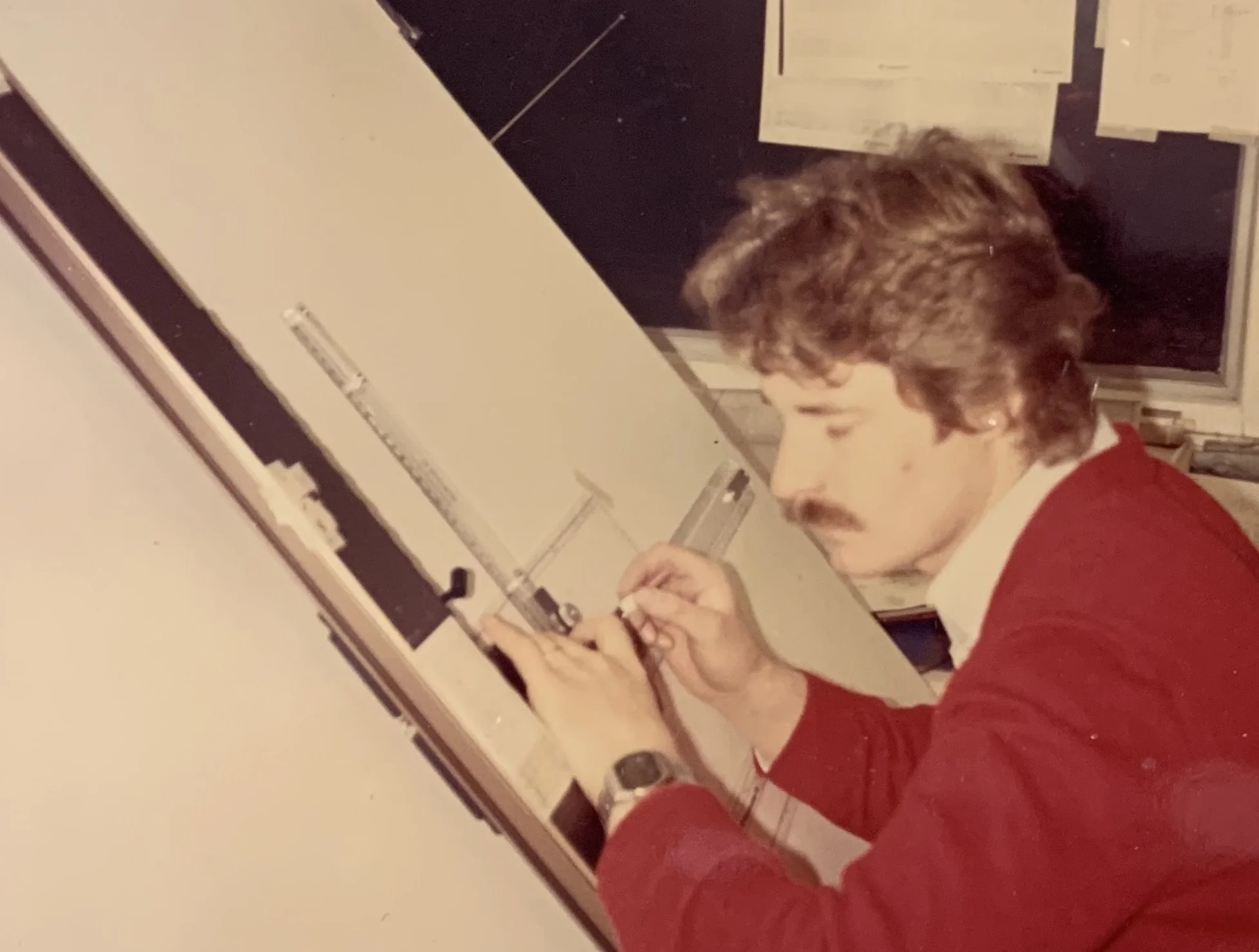
Design work looked very different in the 1980s. Back then, equipment drawings were created on large drafting boards used by designers and project managers. The boards resembled movable tables and could be positioned either horizontally or vertically.
Each job began by calibrating the rulers. Drawings were made on paper or plastic film using technical pens – most commonly 0.25, 0.5 or 0.7 mm – with templates to support the work. Every drawing was numbered and named, and most text was written by hand, making a neat handwriting style an essential skill. Copies were then produced for the customer, while the originals were archived in purpose‑built cabinets.
Drawings were shared by post and later by fax. At first, only A4 sheets could be faxed, but as technology improved, larger drawings were assembled from multiple strips once longer A4 feeds became available. By the late 1990s, email had significantly sped up communication.
Raumaster acquired its first computers in 1986, but the shift to digital design began only in the early 1990s with the introduction of Vertex CAD and three initial licences. For a time, drafting boards and computers were used in parallel.
Design shifted from drafting boards to computers in the 1990s. The last project drawing made on a board was completed in 1997.
The last drawing sent to a customer that was produced on a drafting board was completed in 1997, after which all work moved fully to 2D‑CAD. With the right software identified, the parent company transitioned more broadly to 3D design in 2019, requiring extensive training as well as system integrations with the ERP environment. At Raumaster Paper, 3D design had already been adopted earlier.

Where drafting‑board work always started from a blank sheet, today’s designers make extensive use of existing models that can be adapted and refined. Raumaster still employs people who worked with drafting boards – and one original board can still be found on the second floor of the Nortamonkatu office.
Today, design is carried out almost entirely with 3D software, and drawings are delivered electronically. Some workshops receive data directly into their systems, and in certain customer environments, equipment is designed and integrated in real time as part of a larger operational whole.
Read also >>> Over the Years: A Set of Wheels, From a Sausage Lorry to a GT Volvo