Master of Technology – Teppo Lehtonen: “Keeping a close eye on high operating speeds”
Teppo Lehtonen works at Raumaster Paper Oy as Chief Engineer for winders. At the heart of his diverse role is the execution of design work, which requires both a strong understanding of machinery and great collaboration and organisational skills.
When the design phase begins in a Raumaster Paper project, Lehtonen starts by reviewing the technical details required to carry out the project from a design perspective. Together with the Head of Design, he allocates design resources, assigns responsibilities and schedules the different design phases.
“Design work starts from layout drawings. I guide the designers’ work and occasionally take part in design tasks myself. In addition, I prepare layouts for sales and initiate, manage and maintain product development projects. My role continues even after the actual design work is completed, as projects involve a great deal of coordination,” Lehtonen says.
“One of my most important tasks is to make the designers’ work easier.”
During projects, he works closely with project managers, electrical automation specialists, mechanical engineers and installation supervisors to ensure that all project phases progress according to plan. Maintaining close contact with customers is also an essential part of his work.
“No two machines are exactly alike – each one is always designed according to specific needs and space constraints. I need a strong practical understanding of how the machines operate, and the role also requires social skills and the ability to organise several matters simultaneously.”
“As Chief Engineer, one of my most important tasks is to make the designers’ work easier so that they can focus on their own core tasks. That means I need to know each designer’s strengths when assigning responsibilities.”
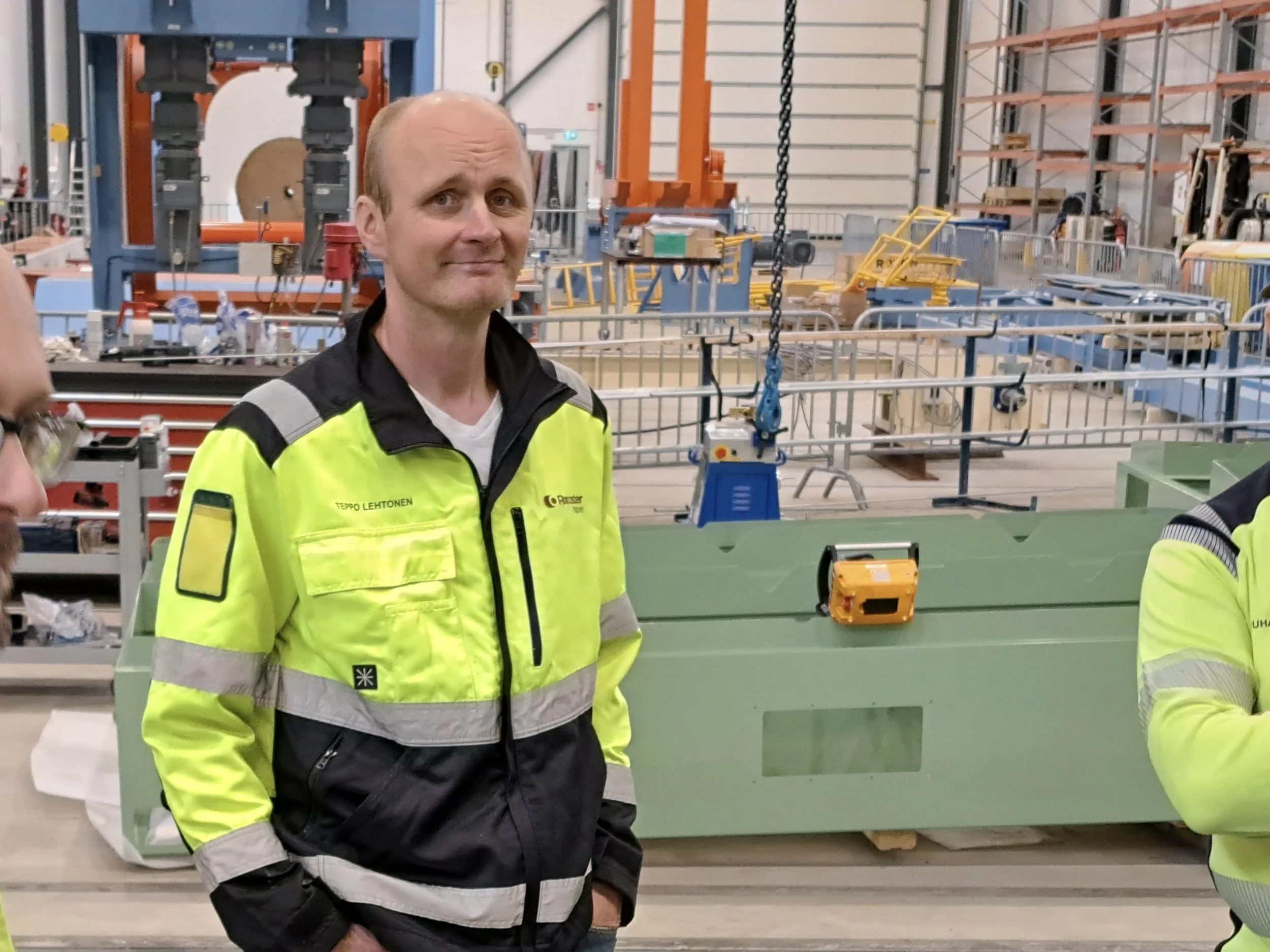
Teppo Lehtonen joined Raumaster Paper Oy in 2010 as a Designer and moved into his current role two years later.
Expertise in a new equipment generation
Lehtonen acts as equipment owner for winders together with experts from electrical automation, the Project Department and Sales. In simple terms, a winder unwinds paper from a steel shaft and rewinds it around a cardboard core. At its best, operating speeds can reach up to 2,500 metres per minute, and with roller widths of up to 7–8 metres, the design work demands a high level of precision.
“The biggest challenge arises when high running speeds are combined with deflections caused by bearing distances and the natural vibration frequencies of the rollers. It is essential that the rotational speed of the roller does not coincide with its natural frequency, as this would result in vibration,” Lehtonen explains.
“The relationship between diameter and length must be carefully designed to ensure that critical frequencies are avoided. Frame structures, heavy rollers and slender shaft ends also have an impact, which means that they also require strength calculations.”
”We ensure high quality and successful projects at every stage by bringing our specialised expertise into a well‑functioning team.”
Lehtonen joined Raumaster Paper Oy in 2010 as a Designer and moved into his current role two years later. Prior to that, having graduated as a Bachelor of Mechanical Engineering in 2006, he worked for around five years in similar roles involving equipment for the paper industry. Despite his extensive experience, learning continues to be part of the job.
“The work has changed in many ways. I have had the opportunity to see at close range how the equipment has improved as we have developed a new generation of machines that respond to today’s requirements. A major and important part of this development has been improving machine safety, which has received significant attention,” Lehtonen says.
Master of Technology – how is technology mastered?
Teppo Lehtonen, Chief Engineer for winders, Raumaster Paper: “Continuous interaction in all directions is an essential part of everyday work. We ensure high quality and successful projects at every stage by bringing our specialised expertise into a well‑functioning team. We build reliable and durable machines in which the end user has been taken into account in terms of functionality, safety and ergonomics, as well as durability and maintainability.”